
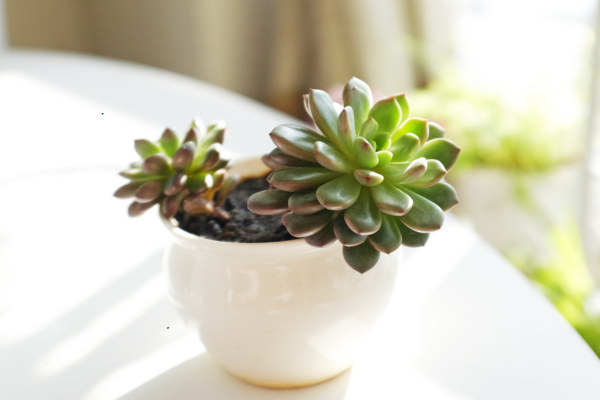
I spent an embarrassingly long time propagating a clustering Haworthia the hard way, taking individual leaf cuttings from a plant that was practically begging to be divided instead. The offsets were already there, already rooted into the same root mass as the parent, already essentially independent plants sharing a pot. Instead of simply separating them, I kept pulling leaves and waiting months for uncertain results, because leaf propagation was the method I’d learned first and defaulted to without really considering whether it was the right tool for this particular plant. Once I finally divided the clump properly, I had several new, already-established plants within a single afternoon, a stark contrast to the slow, uncertain leaf cuttings I’d been fussing over for months.
Clustering succulents, species that naturally produce offsets and grow into dense, multi-headed clumps over time, present a choice that doesn’t come up with solitary-growing species. Both division and cuttings can work, but they’re suited to genuinely different situations, and picking the wrong one wastes time, risks unnecessary plant damage, and often produces worse results than the method actually suited to what you’re working with.
What Makes Clustering Species Different
Many succulent genera, various Haworthia, Gasteria, Sansevieria, and numerous Echeveria and Sempervivum varieties among them, naturally produce offsets, essentially genetically identical clones that grow from the base of the parent plant and, over time, develop into an independent plant with its own root system while still remaining physically attached to or growing alongside the parent. This growth habit is fundamentally different from solitary species that only produce a single rosette or body and must be propagated through leaf or stem cuttings if vegetative propagation is desired at all.
The presence of these offsets is what makes division a genuinely viable option, since you’re not creating a new plant from a fragment and hoping it develops roots, you’re separating something that, in many cases, has already done that work naturally as part of the parent plant’s own growth. This distinction matters enormously for propagation strategy, and defaulting to cuttings out of habit, the way I did with that Haworthia, overlooks a method that’s often both easier and more reliable for exactly this kind of plant.
When Division Is the Better Choice
Division makes the most sense when a clustering plant has produced offsets that are large enough to have developed, or be close to developing, their own independent root systems. An offset with visible roots of its own, or one that’s grown substantially in size relative to the parent, is typically ready for separation, and dividing at this stage produces a new plant that’s already established rather than one that needs to go through the uncertain rooting process cuttings require.
The process itself, while requiring care, is considerably more straightforward than most cutting propagation. Gently removing the plant from its pot, similar to the careful approach described when discussing repotting rare succulents without triggering transplant shock, and identifying where an offset connects to the parent, whether through a shared root mass or a thin rhizome-like connection, allows for a clean separation, often by gently teasing roots apart by hand or using a clean, sharp tool only where truly necessary. Because the offset frequently already has its own roots, it can often be potted directly into appropriate soil and treated much like an established plant, skipping the callusing and uncertain rooting period a cutting requires entirely.
Division also tends to be lower-stress for the parent plant overall, since you’re removing something that was already a semi-independent structure rather than wounding the parent to harvest tissue for cuttings. For genuinely rare or slow-growing specimens, minimizing unnecessary stress on the parent, the same principle behind choosing micro-cutting techniques for extremely slow-growing species when cuttings are necessary, makes division the gentler option whenever it’s genuinely available as a choice.
When Cuttings Are Still the Right Tool
Cuttings remain necessary, and often preferable, in situations where division simply isn’t possible or where a plant’s offsets haven’t developed enough independent structure to make separation viable. A young clustering plant that’s only just begun producing small offsets, not yet large enough to have meaningful root development of their own, isn’t a good candidate for division, forcing a separation at this stage risks damaging both the tiny offset and the parent plant’s root system for a new plant that likely wouldn’t survive the transition anyway.
Cuttings are also the only real option for propagating solitary, non-clustering species entirely, and remain useful even for clustering species when the specific goal is maximizing the number of new plants produced from limited material, since a single leaf or stem section can sometimes be divided into more individual cuttings than a plant would naturally produce as separate offsets within the same timeframe.
There’s also a practical case for cuttings when a clustering plant has grown into an extremely dense, tightly packed clump where individual offsets can’t be separated without significant risk of damaging multiple plants at once in the process. In these situations, taking selective cuttings from the outer, more accessible portions of the clump can sometimes be gentler overall than attempting to fully divide a tangled root mass.
Making the Right Call for a Specific Plant
The decision really comes down to examining the specific plant in front of you rather than defaulting to whichever method you’re more comfortable with. Offsets with visible independent roots, reasonable size relative to the parent, and a root mass that can be separated without excessive force are strong signals that division is both possible and preferable. A plant that’s solitary, too young to have developed separable offsets, or so densely clustered that separation risks broad damage points more toward cuttings, or in some cases toward simply waiting until the plant’s growth habit makes one method more clearly appropriate than the other.
Timing matters across both methods too, and this is where general seasonal knowledge becomes relevant regardless of which technique you choose. Attempting either division or cuttings during a plant’s dormancy period reduces success rates considerably compared to working during active growth, since a plant’s capacity to establish new roots, recover from separation stress, or callus and root a cutting all depend on the same active metabolic processes that dormancy specifically suspends. Whichever method fits the plant, timing it to align with active growth gives it the best realistic chance of success.
The Broader Lesson
My mistake with that Haworthia wasn’t really about technique, both leaf cuttings and division are valid, well-established propagation methods. It was about not stopping to actually assess what the plant in front of me was offering before defaulting to the method I already knew. Clustering species, in particular, often make the propagation decision considerably easier than solitary species do, if you’re willing to look at what the plant has already done on its own before reaching for a blade.
