
A question that comes up constantly in collector groups goes something like this: “I have a rare Echeveria that’s finally offsetting, should I remove the pup or take a few leaves instead?” It’s a genuinely good question, and the honest answer is that it depends on more factors than most quick online answers account for. Having made both the right and wrong call on this more than a few times with my own plants, I’ve come to think of it less as a simple either-or choice and more as a decision that needs to weigh the specific plant, the specific species, and what you’re actually trying to accomplish.
Understanding the Fundamental Difference
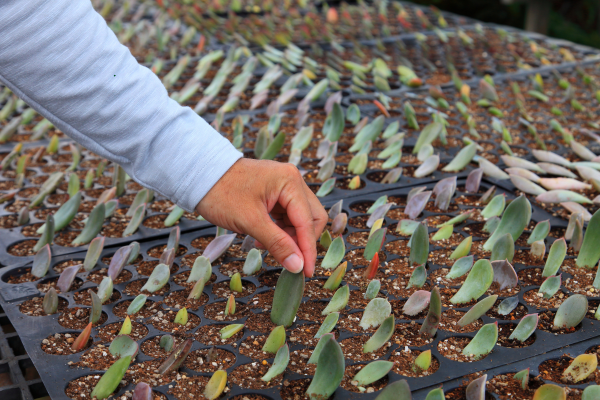
Leaf propagation involves removing an individual leaf from the parent plant and allowing it to develop roots and eventually a small new rosette entirely on its own, using energy stored within that single leaf until the new plant becomes self-sufficient. Offset propagation, sometimes called division, involves separating a naturally occurring “pup,” a smaller plantlet the parent plant produces around its base or along its stem, which already has at least some independent root development and stored energy of its own before you ever separate it from the parent.
This fundamental difference in starting resources explains most of the practical distinctions between the two methods when it comes to success rate, speed, and overall risk to both the new plant and the parent specimen.
Why Offsets Tend to Be More Reliable
An offset generally arrives with a head start that a single leaf simply doesn’t have. By the time a pup is large enough to reasonably separate, it often already has some root development, a functioning growth point, and enough stored resources to support itself through the stress of separation and the following establishment period. This gives offset propagation a meaningfully higher success rate for most species compared to leaf propagation, particularly for rare, slow-growing plants where a single leaf’s limited energy reserves may simply not be enough to fuel both root development and new growth before the leaf’s stored resources run out.
This advantage becomes especially relevant for the kind of genuinely rare, expensive specimens we’ve discussed throughout this series, where a failed leaf propagation attempt represents wasted material from an already scarce parent plant, while a well-timed offset separation carries comparatively lower risk of complete failure.
When Offsets Simply Aren’t Available
The obvious limitation of offset propagation is that it only works when a plant is actually producing offsets in the first place, and many rare species, particularly slower-growing or naturally solitary-growing plants, may not offset readily, or at all, especially while young or under less than ideal growing conditions. Species like many Lithops varieties and certain solitary cactus species discussed in 10 Rare Succulent Varieties Every Collector Should Know rarely if ever produce separable offsets under typical home growing conditions, leaving leaf propagation, seed propagation, or in some cases no realistic propagation option at all beyond acquiring additional specimens.
In these situations, the comparison between leaf and offset propagation becomes somewhat moot, since the plant’s own natural growth habit has already determined which methods are even viable, regardless of which approach might theoretically produce better results in an ideal scenario.
Risk to the Parent Plant
This is where the safety consideration in the article title really comes into focus, and it’s a factor that’s easy to overlook when the main concern is just successfully creating a new plant. Removing a leaf from a healthy, well-established parent typically causes minimal stress to the parent itself, since a mature plant usually has plenty of leaves and the loss of one, taken carefully to avoid damaging the stem, heals quickly without threatening the parent’s overall health.
Separating an offset carries somewhat more inherent risk to the parent, particularly if the offset is removed before it has developed sufficient independent roots, or if the separation process damages the parent’s own root system or stem tissue in the process. This risk is generally manageable with careful technique and appropriate timing, but it’s worth taking seriously with genuinely rare, irreplaceable parent specimens, where an aggressive or poorly timed offset removal could set back or damage a plant that took years to reach its current size and condition.
Which Method Suits Variegated and Crested Specimens
For variegated succulents, discussed at length in Variegated Succulents Explained: Why They’re So Expensive, the choice between leaf and offset propagation carries an additional layer of consideration beyond simple success rate. Because variegation follows an unpredictable, chimeral pattern within the plant’s tissue, a leaf taken from a heavily variegated section may lack enough chlorophyll-producing tissue to successfully root at all, while an offset that’s already showing a balanced mix of variegated and green tissue, and already has its own independent growth point established, tends to offer a more reliable path to a new plant that retains the parent’s variegation pattern.
Crested and monstrose specimens, covered in Monstrose and Crested Succulents: Genetic Mutations Explained, present a related consideration: since the mutation responsible for their unusual growth form is tied to the specific growing point affected, propagation generally needs to come directly from cuttings or offsets taken specifically from the mutated tissue itself, rather than from any leaf, which in most crested and monstrose species isn’t a viable propagation method in the first place regardless of the usual leaf-versus-offset comparison.
Technique Considerations for Each Method
Successful leaf propagation depends heavily on how the leaf is removed from the parent. A gentle, twisting motion that removes the entire leaf cleanly at its base, including the small basal node where new growth will eventually emerge, tends to produce far better results than simply snapping or cutting a leaf partway, which often leaves behind tissue that lacks the growth point needed to develop into a new plant at all. This is a common, frustrating mistake among beginners attempting leaf propagation for the first time, and it’s worth practicing on more common, less valuable succulents before attempting the technique on a genuinely rare specimen’s leaves.
Offset separation technique varies somewhat depending on how the offset is attached to the parent. Some offsets separate easily with gentle pressure once they’ve developed sufficient size and root structure, while others are connected via a stolon or underground runner that needs to be carefully cut with a clean, sharp tool rather than pulled, to avoid damaging both the offset’s own root development and the parent plant’s root system in the process. Whichever method the specific attachment calls for, following the callusing approach described in How to Propagate Rare Succulents Without Killing Them before introducing the newly separated offset to soil applies just as much to offsets as it does to leaves and cuttings.
Making the Decision for Your Specific Plant
In practice, the choice often comes down to what your specific plant is actually offering you at the time. A plant that’s producing healthy, appropriately sized offsets gives you a generally more reliable propagation path, and taking advantage of that natural offsetting tends to make more sense than removing leaves purely for the sake of trying an alternative method. A plant that isn’t offsetting, whether due to species tendency, age, or growing conditions, leaves leaf propagation, where viable for that species, as the more practical option, accepting the somewhat lower success rate as the tradeoff for having any propagation option at all.
For genuinely precious, hard-to-replace rare specimens, it’s often worth taking a conservative approach regardless of which method you choose: propagating only when the parent plant is demonstrably healthy and actively growing, taking only a modest amount of material rather than aggressively harvesting multiple leaves or offsets at once, and accepting that patience, both in choosing the right moment and in waiting out the resulting rooting process, tends to matter more to overall success than which specific method you ultimately decide to use.
