
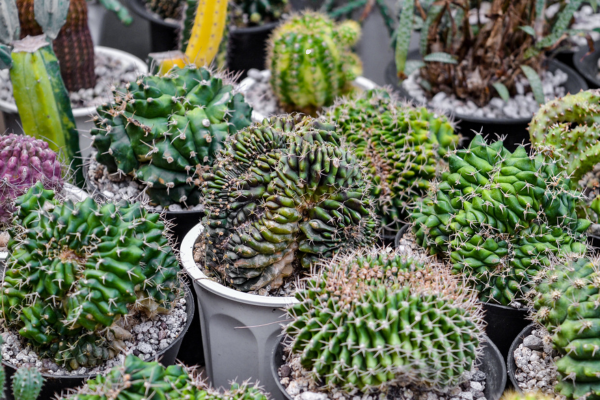
The first crested succulent I ever saw in person stopped me mid-sentence at a plant show. It was a small cactus, or at least it had started as one, except instead of the usual single growing point pushing straight up, it had fanned out into this wavy, folded ridge that looked almost like coral or a tiny brain. The seller told me it had taken years to reach that size and that there was no way to guarantee producing another one like it, even from cuttings of the exact same plant. That last part is what stuck with me, because it’s really the key to understanding this entire category of succulents.
Two Different Mutations, Often Confused
Crested and monstrose growth get lumped together constantly, and while they’re related phenomena, they’re technically distinct mutations with different underlying causes and different visual results.
Crested growth, also called cristate growth, occurs when a plant’s normal single growing point, called the apical meristem, mutates into an elongated line rather than staying as a single point. Instead of growing upward or outward symmetrically from one spot, the plant now grows along this line, producing the fan-shaped, wavy, folded appearance that’s become the signature look of crested cacti and succulents.
Monstrose growth, by contrast, involves a mutation that affects how a plant’s growing points develop more broadly, often causing multiple abnormal growing points to form instead of the plant’s normal single or predictable branching pattern. Rather than the smooth, ribbon-like fan of a crest, monstrose growth tends to produce a lumpier, more irregular, almost tumor-like form, with growth pushing out in unpredictable directions and at unpredictable intervals.
Some plants display a combination of both mutations simultaneously, sometimes called “monstrose-cristate,” which produces forms that combine the ribboning of a crest with the irregular, lumpy growth of monstrose mutation, resulting in some of the most visually chaotic and, to collectors, most desirable specimens.
Why These Mutations Happen
The honest answer is that nobody fully understands the exact triggers behind crested and monstrose mutations, and that uncertainty is part of what makes them so difficult to intentionally produce. Some researchers believe these mutations can be triggered by physical damage to the growing point, whether from insects, mechanical injury, or environmental stress like extreme temperature fluctuations. Others point to spontaneous genetic mutations that occur during normal cell division, unrelated to any external trigger at all, similar in some ways to the unpredictable mutations behind variegation that we discussed in Variegated Succulents Explained: Why They’re So Expensive.
What’s clear is that these mutations occur at a low, essentially random rate across many different succulent and cactus species, and there’s no reliable method for causing them on purpose. Growers have experimented with various stress-inducing techniques over the decades, from deliberately wounding growing points to exposing plants to unusual chemical or environmental conditions, and while some of these methods appear to slightly increase the odds of triggering a mutation in large-scale trials, none of them work reliably enough to guarantee results on an individual plant. This is genuinely different from something like the crossbreeding involved in creating a hybrid such as String of Dolphins, which we discussed in String of Pearls vs. String of Dolphins: A Complete Comparison — hybridization is a deliberate, repeatable process, while triggering a crest or monstrose mutation remains largely a matter of chance.
Why Propagation Is So Tricky
Once a crested or monstrose mutation appears, preserving it through propagation requires care that goes beyond typical succulent cutting or division. Because the mutation is specific to the affected growing point, cuttings need to be taken directly from the mutated tissue rather than from any normal, non-mutated growth that might also be present on the same plant. Many crested and monstrose specimens actually produce some normal, non-mutated growth alongside their mutated portions, sometimes called “reversion” growth, similar conceptually to the reversion that occurs with variegated succulents, though the underlying mechanism is different.
If a propagator isn’t careful, or if reversion growth is inadvertently used for propagation instead of the mutated tissue, the resulting new plant will grow completely normally, without any trace of the crest or monstrose form, even though it came from a mutated parent. This is one of the reasons truly well-formed, consistently crested specimens carry premium prices, since successfully propagating and maintaining the mutation over multiple generations requires skilled, attentive care rather than the straightforward leaf-and-offset propagation that works for most standard succulents.
Common Species Where These Mutations Appear
While crested and monstrose forms can technically occur in almost any succulent or cactus species, some plants seem to display these mutations somewhat more frequently than others, likely due to a combination of their popularity in cultivation and certain genetic tendencies that aren’t yet fully understood.
Euphorbias are particularly well known for producing dramatic crested and monstrose forms, with crested Euphorbia lactea, often sold under names referencing its coral-like appearance, being one of the more commonly available examples despite still being considered a specialty item rather than a mainstream houseplant. Various cactus genera, including Cereus, Opuntia, and Mammillaria, also frequently produce crested specimens that show up regularly, if not commonly, in specialty nurseries and collector circles.
Among true succulents rather than cacti, crested Echeveria and crested Aeonium specimens do appear, though somewhat less frequently than crested cacti, and when they do appear, they tend to command particularly high interest given how comparatively rare crested growth is within these genera compared to cactus varieties.
Grafting as a Preservation Technique
Because many crested and monstrose plants, particularly certain Euphorbia varieties, lack the chlorophyll or structural stability to survive well on their own root system, grafting is often used both to help the plant thrive and to speed up its otherwise very slow growth. Grafting involves attaching a cutting from the crested or monstrose plant onto the root system and lower stem of a hardier, faster-growing species, allowing the mutated top growth to benefit from the more vigorous root system beneath it.
This technique, which we explore in more general terms in Grafting Techniques for Delicate Succulent Varieties, is particularly common with crested Euphorbias, where a grafted specimen will often grow noticeably faster and larger than an equivalent plant left to grow on its own roots. It does introduce some long-term considerations, though, since the rootstock used for grafting typically has a finite lifespan, and an aging or declining rootstock can eventually limit the health of even a well-established crested specimen sitting on top of it.
Caring for Crested and Monstrose Specimens
In terms of day-to-day care, crested and monstrose succulents generally follow the same basic light, water, and soil requirements as the standard form of whatever species they originated from. The main additional consideration is being more attentive to reversion growth, checking periodically for any new growth points that look like they’re reverting to a normal, non-mutated pattern, and, for growers interested in maintaining a clean, fully crested or monstrose specimen, removing that reversion growth before it has a chance to dominate the plant’s overall growth.
It’s also worth noting that the irregular, folded, or lumpy growth patterns typical of these mutations can sometimes trap moisture in ways that a normal, smoother plant form wouldn’t, particularly in the folds and crevices of a heavily crested specimen. This can slightly increase susceptibility to fungal issues in humid conditions or with careless overhead watering, making good airflow and careful, targeted watering somewhat more important than with non-mutated succulents of the same species.
Why Collectors Value Them So Highly
Ultimately, what makes crested and monstrose succulents so compelling to collectors is the same thing that makes them difficult to produce reliably: genuine, unrepeatable uniqueness. Unlike a variegated plant, where at least the general pattern type can sometimes be somewhat anticipated based on how the parent plant’s variegation is distributed, a crested or monstrose specimen’s exact folding pattern, growth direction, and overall shape are essentially one-of-a-kind, shaped by the specific, unpredictable way that individual mutation happened to develop.
Owning one means owning something that, quite literally, cannot be exactly replicated, even from a cutting of the very same plant. That combination of rarity, unpredictability, and genuine visual strangeness is a big part of why these mutated forms have earned such a devoted following within the broader succulent collecting world, and why a small, oddly-shaped crested specimen can sometimes draw more attention at a plant show than a large, perfectly symmetrical, and far more common succulent standing right next to it.
