
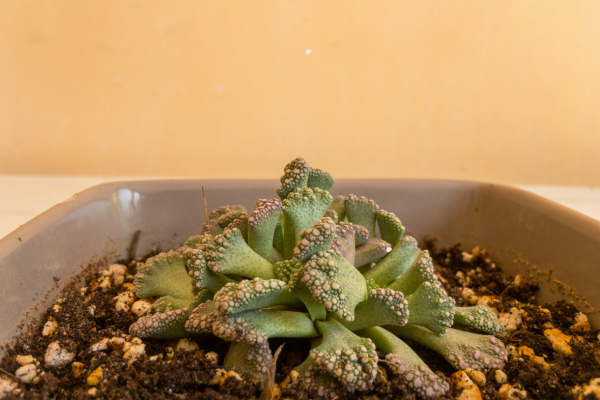
A friend once asked me why I’d pay more for a small, slightly awkward-looking Haworthia than I would for a huge, perfectly symmetrical Echeveria three times its size. It’s a fair question, and one that doesn’t really have a satisfying answer if you’re thinking about succulents purely in terms of size or visual polish. Rarity in this hobby runs on a completely different set of rules, and once you understand what those rules actually are, prices that seemed baffling at first start to make a lot more sense.
Rarity Isn’t One Thing
The word “rare” gets used pretty loosely in succulent listings, and honestly, some of that looseness is just marketing. But when collectors use the term seriously, they’re usually referring to one or more of several genuinely distinct factors, and a plant’s real market value tends to depend on which of these factors apply, and how strongly.
Genetic Scarcity
Some succulents are rare simply because the traits that make them desirable occur unpredictably and can’t be reliably reproduced on demand. Variegation is the clearest example of this, something we unpacked in detail in Variegated Succulents Explained: Why They’re So Expensive. A variegated mutation might show up in one seedling out of thousands, and even once it appears, propagating that specific plant while preserving its variegation is genuinely uncertain. Crested and monstrose growth patterns fall into this same category — mutations that occur rarely, can’t be intentionally bred, and have to be propagated carefully once found.
This kind of rarity tends to be the most expensive and the most volatile in terms of pricing, because supply is fundamentally capped by biology rather than by how many growers decide to plant seeds this season. No amount of demand changes how often a genuine mutation occurs in nature.
Growth Rate
A surprising number of “rare” succulents aren’t actually genetically unusual at all — they’re simply slow. Species like Ariocarpus fissuratus or Aloe polyphylla, both of which we touched on in 10 Rare Succulent Varieties Every Collector Should Know, can take many years or even decades to reach a mature, sellable size from seed. A nursery simply can’t speed up that timeline, which means the supply of mature specimens at any given moment is limited by how many growers started cultivating that species years or decades earlier, not by current market demand.
This creates an interesting dynamic where a species can be considered rare and expensive for a long time, and then gradually become more available as more growers who started cultivation years earlier finally have mature stock ready to sell. Slow-growth rarity is, in a sense, temporary in a way that genetic rarity often isn’t, though “temporary” can still mean a decade or more.
Habitat and Geographic Restriction
Some species are rare because they naturally occur in a very narrow geographic range, sometimes a single mountain range or a specific type of rock formation, and nowhere else on earth. Aloe polyphylla, restricted almost entirely to the Lesotho highlands, is a good example of this kind of rarity. When a species’ natural range is this limited, wild populations are often fragile, which has led to legal protections and CITES restrictions on international trade for a number of succulent and cactus species, something we mentioned regarding Euphorbia obesa in the same article referenced above.
This type of rarity intersects with ethical sourcing in a way the other categories don’t as directly. A plant that’s rare because of habitat restriction is often also a plant where buying wild-collected specimens does real damage to already vulnerable populations, which is part of why reputable sellers emphasize seed-grown or nursery-propagated origins for these particular species.
Breeding Complexity
Hybrids that require deliberate, skilled hand-pollination to create, and that then take years to stabilize into a consistent, reliably reproducing form, represent another distinct category of rarity. String of Dolphins, which we compared directly to its parent species in String of Pearls vs. String of Dolphins: A Complete Comparison, is a good example — not genetically unstable in the way a variegated mutation is, but limited by the fact that creating more of this specific hybrid combination isn’t something that happens accidentally or at scale.
This kind of rarity often decreases over time as more growers acquire stock and begin propagating and distributing cuttings themselves, gradually easing the scarcity that existed when the hybrid was newly created. A hybrid that was genuinely rare five years ago might be reasonably common today, simply because enough time has passed for cuttings to circulate widely through the hobby.
Farina, Coloration, and Delicate Features
Sometimes rarity isn’t about how hard a plant is to produce at all, but about how hard it is to maintain in pristine condition. Echeveria varieties with thick, powdery farina, something we discussed regarding Echeveria laui and ‘Blue Sky’ in The Rarest Echeveria Varieties in the World, are technically not that difficult to propagate in terms of raw plant count. What’s genuinely rare is a specimen with an intact, unmarked, evenly coated surface, since farina damages easily through handling, water contact, or even minor environmental stress, and it doesn’t fully regenerate once damaged.
This means the plant itself might not be scarce, but a specimen in truly excellent, undamaged condition is. This distinction matters a lot when you’re evaluating whether a listed price is justified — a farina-coated Echeveria priced as “rare” should show genuinely pristine, unmarked coloration to justify that premium, not just belong to a species that’s capable of producing that coloration under ideal conditions.
Fashion and Collector Demand
It would be dishonest to leave this factor out, because it’s real and it moves prices significantly. Sometimes a species or variety becomes rare in terms of market price simply because demand spikes faster than supply can respond, often driven by social media exposure or a particularly striking photo that circulates widely. This kind of rarity is the least stable of all the categories here, since prices driven primarily by trend and visibility tend to correct once supply catches up or attention shifts to something else.
It’s worth being a little skeptical of pricing driven mainly by this factor, since a plant that’s expensive purely because it’s currently popular, rather than because of any of the genuine biological or ecological factors described above, is more likely to become significantly more affordable within a year or two as more growers propagate it in response to the demand.
How to Evaluate a “Rare” Listing Yourself
Given all of this, it’s worth developing a habit of asking which category of rarity actually applies before paying a premium price for any succulent labeled as rare. A genuinely variegated, stably patterned specimen justifies its price through genetic unpredictability. A mature, decades-old Ariocarpus justifies its price through growth rate. A pristine, unmarked Echeveria laui justifies its price through the difficulty of maintaining its delicate coating.
A plant that’s simply trendy right now, without any of these underlying factors, is a riskier purchase from a value standpoint, even if it’s perfectly enjoyable to grow and display. None of this means trend-driven plants aren’t worth buying if you genuinely love how they look — but understanding the difference helps you make more informed decisions about where your money goes, especially as you build a collection with some intention behind it rather than just chasing whatever’s circulating widely at the moment.
Rarity Isn’t Static
Perhaps the most important thing to internalize about succulent rarity is that it changes over time, sometimes in both directions. A species considered rare a decade ago might be common today because more growers learned to propagate it successfully. A previously common species might become genuinely scarce if habitat pressures increase or if a disease affects cultivated stock widely. Understanding the underlying reason behind a plant’s current rarity gives you a much better sense of whether that status is likely to persist, increase, or fade as the years go on, which is honestly one of the more interesting parts of following this hobby closely over time.
