
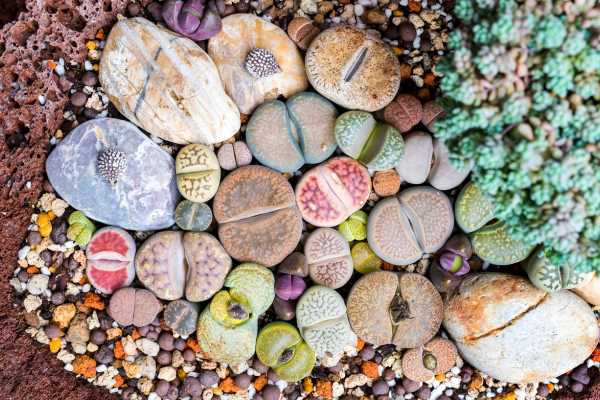
The first time most people encounter a Lithops, they don’t realize they’re looking at a plant at all. It happened to me at a small nursery years ago — a tray of what looked like an odd assortment of speckled pebbles sitting next to the cacti, priced individually, which seemed strange until the owner picked one up and told me to look closer. That’s the thing about Lithops. They’re built entirely around the art of not looking like a plant, and once you understand why, identifying them (and telling the good specimens from the mediocre ones) starts to make a lot more sense.
Lithops belong to the Aizoaceae family and are native almost exclusively to the arid, rocky regions of Namibia and South Africa. In the wild, they grow flush with the ground among quartz and granite fragments, and their mottled, stone-colored surface is a survival mechanism — camouflage against grazing animals that would otherwise treat them as a snack in an environment with almost nothing else green to eat. Understanding that origin story matters, because nearly every identification tip and care rule for Lithops traces back to replicating those exact rocky, dry, sun-blasted conditions.
What You’re Actually Looking At
A Lithops plant isn’t a rosette or a cluster of individual leaves the way most succulents are. It’s technically a single pair of fused, swollen leaves, split by a narrow fissure across the top. That fissure is where new growth and, eventually, flowers will emerge. Over time, a healthy Lithops can split into multiple heads, forming small clumps, but even a mature multi-headed specimen is really just several of these paired-leaf structures growing side by side.
The top surface, called the “window,” is often translucent or semi-translucent, and it’s covered in patterns that vary enormously between species — spots, dendritic lines, cracks, or islands of color that range from dull gray-green to rusty orange to deep maroon. This is the single most useful identification feature for beginners, since two Lithops species can be nearly identical in shape but completely different in surface pattern.
Telling Species Apart
There are around 37 recognized Lithops species, and within those, dozens of named varieties and cultivars, which makes precise identification genuinely difficult even for experienced growers. That said, a few visual cues go a long way:
Lithops optica tends to have a more elongated, almost oval body shape with a smoother, glossier surface than most other species, and the ‘Rubra’ variety in particular shows a deep reddish-purple coloration that’s fairly distinctive once you’ve seen it.
Lithops karasmontana usually shows a more heavily textured, cracked-looking window with grayish or brownish tones, and the surface pattern often looks like dried, cracked earth — a texture that mirrors its rocky habitat almost too perfectly.
Lithops aucampiae typically has a rounder, more domed body with reddish-brown coloring and less intricate window patterning than karasmontana, making it one of the easier species for beginners to grow successfully.
If you’re trying to figure out exactly which species you’ve purchased, the safest approach is comparing your plant against verified botanical photos rather than relying on nursery labels alone, since mislabeling is extremely common in the trade — a topic we cover in more detail in How to Spot a Fake or Mislabeled Rare Succulent Online.
Reading the Growth Cycle
One of the most important identification skills with Lithops isn’t about species at all — it’s about recognizing what stage of the growth cycle your plant is in, because that dramatically changes what “healthy” looks like.
In late summer or early fall, mature Lithops produce a single daisy-like flower, usually yellow or white, that emerges from the central fissure and can seem disproportionately large compared to the plant itself. After flowering, the plant enters a phase where it starts growing a new pair of leaves inside the existing ones, essentially absorbing the old pair to fuel the new growth. This is where most beginners panic, because the old leaves visibly shrivel, wrinkle, and appear to be dying.
They’re not dying. This process, sometimes casually called “molting,” is completely normal and can take anywhere from a few weeks to a couple of months depending on the season and growing conditions. The mistake almost everyone makes at this stage is watering the plant because the shriveling looks like drought stress. In reality, watering during this phase often causes the new leaves to split or rot, since the plant is actively drawing on its own stored moisture and doesn’t need supplemental water. For a deeper look at how overwatering specifically affects succulents during dormancy and growth transitions, see Signs of Overwatering vs. Underwatering in Rare Species.
Distinguishing Healthy From Struggling Plants
Beyond species identification, learning to read a Lithops’ general condition is arguably more useful day to day. A healthy specimen should feel firm and slightly taut, almost like the surface is under light pressure from within. If a Lithops feels soft, spongy, or wrinkled outside of its normal molting period, that’s typically a sign of underwatering combined with the intense heat and light the plant is used to receiving in habitat but often doesn’t get indoors.
Conversely, a Lithops that looks stretched, elongated, or unusually pale is showing signs of insufficient light — a condition called etiolation, where the plant grows taller and thinner in an attempt to reach more sunlight. This is extremely common in Lithops kept on windowsills that seem bright to us but don’t come close to the direct, intense sun exposure these plants receive in their native desert habitat. We go into this specific issue, including how to recognize and correct it before permanent damage sets in, over in Etiolation Explained: Why Your Succulent Is Stretching.
A Note on Sourcing
Because Lithops are slow-growing and their wild populations face genuine conservation pressure in parts of southern Africa, sourcing matters more with this plant than with almost any other succulent on the beginner market. Seed-grown specimens from reputable growers take years to reach a saleable size, which is part of why authentic, well-grown Lithops often cost more than casual buyers expect for something so small. Extremely cheap listings, especially those selling large mature clumps at bargain prices, are worth approaching with some skepticism, since they sometimes originate from wild-collected stock rather than cultivated sources.
Common Identification Mistakes Beginners Make
A lot of new growers assume that any small, dual-lobed succulent with a mottled top is a Lithops, but there’s actually a closely related genus, Conophytum, that gets confused with Lithops constantly. Conophytum species tend to have a more rounded, less distinctly split top and often show more dramatic color shifts during their own growth cycle. The care requirements between the two genera are similar but not identical, particularly around timing of dormancy, so misidentifying one for the other can lead to watering at exactly the wrong moment.
Another frequent mix-up happens with Pleiospilos, sometimes nicknamed “Split Rock,” which shares the stone-like camouflage strategy but has a noticeably different leaf shape — thicker, more triangular, and less uniformly paired than true Lithops.
Getting Comfortable With Uncertainty
Honestly, even after years of growing them, I still can’t identify every Lithops species on sight with full confidence, and neither can most collectors I’ve talked to. The visual variation within a single species can be almost as wide as the variation between species, especially since so many specimens in cultivation are hybrids or unlabeled seedlings from mixed batches. Rather than treating identification as a box to check, it’s more useful to think of it as an ongoing skill — one that gets sharper the more specimens you handle, photograph, and compare over time.
What matters more in the beginning is learning to read the plant’s condition rather than pinning down its exact taxonomic name. A Lithops that’s firm, appropriately dormant or actively growing depending on the season, and sitting in strong, direct light is a healthy Lithops regardless of which of the 37 species it happens to be. The species name becomes more relevant once you’re trying to source specific varieties or breed for particular patterns, which is a rabbit hole all its own — and one worth falling into once you’ve got the basics down.
