
If you’ve spent any time browsing succulent shops or plant groups online, you’ve probably seen these two trailing succulents mentioned in the same breath, often with someone in the comments insisting they’re basically the same plant. They’re not, and the differences matter more than they might seem at first glance, both in terms of how each plant grows and how much you should expect to pay for a healthy one. Having grown both side by side for a while now, I’ve come to appreciate that they’re really more like distant cousins than twins.
Understanding Where Each Plant Comes From
Senecio rowleyanus, commonly known as String of Pearls, is a naturally occurring species native to the arid regions of South Africa and Namibia, where it grows as a trailing groundcover, its round, bead-like leaves minimizing surface area to reduce water loss in intense heat. It’s been in cultivation for decades and is relatively easy to find, which is part of why it’s become something of a houseplant staple.
Senecio peregrinus, or String of Dolphins, tells a different story. It’s a hybrid, believed to have originated from a cross between Senecio rowleyanus and Senecio articulatus (sometimes called Candle Plant), though the exact breeding history isn’t perfectly documented since it emerged through cultivation rather than being formally bred and recorded by a single grower. Because it’s a hybrid rather than a stable, naturally occurring species, String of Dolphins doesn’t breed true from seed, and most specimens in circulation trace back to vegetative cuttings taken from a relatively limited pool of original plants.
The Leaf Shape Tells the Real Story
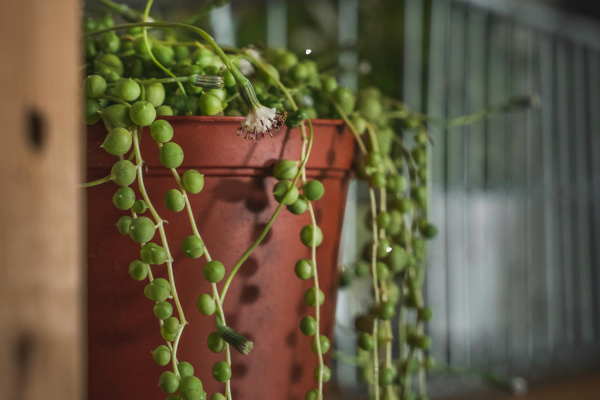
The most obvious difference, and the one that gives String of Dolphins its name, is leaf shape. String of Pearls produces small, nearly perfect spheres along its trailing stems, each with a subtle translucent stripe running along one side that allows light to reach the plant’s internal photosynthetic tissue even when the round shape limits surface area exposure.
String of Dolphins leaves curve and taper in a way that genuinely does resemble a pod of leaping dolphins, with a distinct beak-like point at one end and a curved body that narrows toward the stem. This shape isn’t just a cute coincidence — it reflects the influence of Senecio articulatus in its parentage, which has more elongated, less spherical leaves than rowleyanus. The result is a leaf that’s visually a middle ground between its two parent species, though it leans more toward the dolphin-like curve than toward a fully elongated shape.
Growth Rate and Availability
This is where the practical difference between these two plants becomes most apparent to anyone actually trying to buy one. String of Pearls propagates readily from stem cuttings, roots relatively quickly in the right conditions, and has been cultivated widely enough that healthy, well-trailing specimens are easy to find at a reasonable price in most plant shops.
String of Dolphins, being a hybrid with a more limited original stock and a somewhat slower growth rate, takes noticeably longer to develop the same length of healthy, full trails. A newly rooted cutting of String of Dolphins might take a full growing season or more to reach a length that a comparable String of Pearls cutting achieves in a fraction of the time. This slower pace, combined with the plant’s relative novelty compared to the long-established Pearls, is the main reason healthy, well-developed String of Dolphins specimens command a noticeably higher price, sometimes several times more than an equivalent length of String of Pearls.
Care Differences Worth Knowing
Despite their visual differences, the two plants share most of their basic care requirements, which makes sense given their shared parentage. Both want bright, indirect light, with several hours of gentle direct sun being ideal, and both are prone to stretching and losing their compact bead or dolphin shape if kept in conditions that are too dim. Both also prefer to dry out substantially between waterings, and both are considerably more prone to rot than to drought stress, meaning the most common way to lose either plant is through overwatering rather than underwatering — a pattern we explore more broadly in Signs of Overwatering vs. Underwatering in Rare Species.
Where they diverge slightly is in resilience. String of Pearls, being a straightforward wild species adapted to genuinely harsh natural conditions, tends to bounce back from minor care mistakes a bit more readily than String of Dolphins, which, as a hybrid, sometimes shows less predictable responses to stress. A String of Dolphins that’s been slightly overwatered or under-lit for a period of time may take longer to recover its full health even after conditions are corrected, compared to a String of Pearls in the same situation.
Propagation Considerations
Both plants propagate primarily through stem cuttings rather than leaf propagation, since individual leaves on both species generally lack the ability to root and grow into a new plant on their own — a distinction worth understanding if you’re used to propagating rosette-forming succulents through single leaves. A cutting containing several nodes, laid across moist, well-draining soil, will typically root at each node given enough time and the right conditions.
String of Dolphins cuttings tend to root more slowly and somewhat less reliably than String of Pearls cuttings, which partly explains why the plant remains less widely available despite growing interest. Patience matters more here than with most trailing succulents, and cuttings that seem to be doing nothing for several weeks aren’t necessarily failing — they may simply be establishing roots more slowly than you’d expect based on experience with other, faster-rooting species. For a broader look at propagation timelines and troubleshooting across different succulent types, see How Long Does It Take to Grow a Rare Succulent From Seed?, which, while focused on seed propagation, covers some of the same patience-related expectations that apply here.
Flowering Differences
Both plants are capable of producing small, unusual flowers that some people find surprisingly pleasant-smelling, often compared to cinnamon or vanilla, while others find the scent off-putting. String of Pearls flowers slightly more readily in cultivation than String of Dolphins, though neither plant flowers particularly often indoors without close to ideal light conditions. Flowering isn’t a reliable identification feature on its own, since both plants’ flowers look fairly similar at a glance, small and white with prominent stamens, but it’s worth noting for anyone hoping to see this stage of either plant’s growth cycle.
Which One Should You Actually Choose
If you’re newer to trailing succulents generally, String of Pearls is the more forgiving and widely available starting point, and it gives you a good baseline understanding of how this general growth style behaves before investing in the pricier, slightly more particular String of Dolphins. If you already have experience keeping String of Pearls alive and thriving and you’re looking for something with a bit more novelty and a genuinely distinctive look, String of Dolphins is a natural next step, provided you go in expecting slower growth and a higher price relative to its size.
Neither plant is objectively better than the other — they simply occupy slightly different places in the trailing succulent world, one as an established, reliable classic and the other as a rarer, slower hybrid still working its way toward wider availability. Growing both together, as many collectors end up doing, offers a nice side-by-side lesson in just how much a small difference in parentage can shape a plant’s entire growth personality.
