
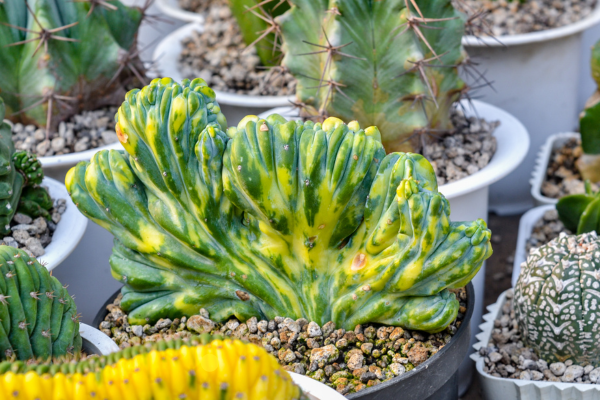
Somewhere around the third or fourth succulent auction I browsed as a beginner, I noticed something strange. Plants that looked, at least to my untrained eye, almost identical to ones selling for a few dollars were listed at ten or twenty times the price, with sellers using words like “stable variegation” and “high contrast” in the title. I remember thinking it had to be some kind of marketing trick. It wasn’t. Variegation is one of those quirks of plant biology that genuinely does justify the price difference, once you understand what’s actually happening inside the leaf.
What Variegation Actually Is
At its core, variegation is a disruption in a plant’s ability to produce chlorophyll evenly across its tissue. Chlorophyll is the pigment responsible for photosynthesis, and it’s also what gives most plant tissue its green color. When a mutation interferes with chlorophyll production in certain cells, those areas lose their green pigment and instead show white, cream, yellow, or sometimes pink and red tones, depending on what other pigments are present underneath.
This isn’t the same as a plant simply having colorful leaves as part of its normal genetics — something like the reddish tones of Echeveria ‘Black Prince’, which we touched on in 10 Rare Succulent Varieties Every Collector Should Know, is a consistent, heritable trait passed down predictably through seed or propagation. Variegation, by contrast, is usually the result of an unstable genetic mutation, a virus, or a chimeral growth pattern, meaning it doesn’t always propagate the same way twice and can appear or disappear across generations of the same plant.
Why Chlorophyll Loss Makes a Plant Weaker, Not Stronger
Here’s the part that trips people up: the very thing that makes variegated succulents visually striking is also what makes them biologically disadvantaged. Chlorophyll is how a plant generates the energy it needs to grow, and a variegated leaf simply has less of it working per square inch of surface area compared to a fully green leaf of the same size.
This means variegated succulents almost universally grow slower than their solid-colored counterparts. They also tend to be more sensitive to intense direct sunlight, since the white or pale sections of the leaf lack the protective pigment that would normally help shield the plant’s tissue from sun damage, yet they still need strong light overall to compensate for reduced photosynthetic capacity. It’s a genuinely difficult balance to strike, and it’s a big part of why variegated plants have a reputation for being finicky compared to their standard-form relatives.
The Propagation Problem
If you’ve ever wondered why a fully variegated succulent seems to cost so much more than one with just a small fleck of color on one leaf, propagation difficulty is the answer. Variegation in succulents typically follows a chimeral pattern, meaning the plant is essentially made up of two genetically distinct types of tissue growing together — one that produces chlorophyll normally and one that doesn’t. Where these two tissue types intersect determines how the variegation is expressed in any given cutting or offset.
Because of this, propagating a variegated succulent is something of a gamble. A leaf cutting taken from a heavily variegated section might not contain enough of the chlorophyll-producing tissue to survive and root at all, since a leaf that’s mostly or entirely white often lacks the energy reserves needed to grow roots and a new rosette. Cuttings taken from a more balanced section have a better chance of rooting successfully but might produce a new plant with different variegation patterns than the parent, or sometimes no variegation at all. This unpredictability is a major reason variegated succulents can’t simply be mass-produced the way solid green varieties are, and it directly explains the price gap. For anyone interested in trying this themselves, the risks and techniques involved are covered more thoroughly in Propagating Variegated Succulents: Special Considerations.
Reversion: The Heartbreak of Variegated Collecting
Even after successfully growing a variegated succulent for months or years, there’s no guarantee it will stay that way. Reversion happens when new growth on a variegated plant emerges fully green, effectively “reverting” to the non-variegated form. This happens because the plant, in a sense, favors the more efficient, fully chlorophyll-producing tissue for new growth, since that tissue can photosynthesize more effectively and support faster development.
Once a section starts producing green growth, it usually continues to do so, and if left unchecked, the green growth can eventually overtake and outcompete the variegated portions entirely. Experienced growers often watch closely for the first signs of reversion and prune away fully green growth points as soon as they appear, in an attempt to redirect the plant’s energy back toward the variegated sections. It’s a bit like a constant, low-level negotiation with the plant’s own biology, and it’s part of why maintaining a variegated collection long-term requires more attention than most people expect going in.
How Pricing Actually Breaks Down
Once you understand the biology, the pricing logic for variegated succulents starts to make a lot more sense. A specimen with variegation only on a single leaf, sometimes called a “sport,” tends to be priced modestly, since there’s real uncertainty about whether that variegation will persist, spread, or vanish entirely as the plant grows. A rosette with variegation running consistently through the center growth point, sometimes described as “stable” variegation, commands a significantly higher price because it suggests, though never guarantees, that new growth will continue to display the trait.
The highest prices tend to go to what collectors call “high contrast” variegation, where the color difference between variegated and non-variegated sections is sharp and dramatic rather than a subtle blend, combined with an overall growth pattern that appears balanced and stable across multiple growth points. These specimens are rare precisely because they represent a kind of biological sweet spot: enough chlorophyll-producing tissue to keep the plant healthy and growing, but arranged in a way that produces a visually striking, relatively stable pattern.
Spotting Genuine Variegation Versus Artificial Tricks
Unfortunately, the high demand for variegated succulents has led to some dishonest practices in the market. Certain sellers use dye injections or bleaching treatments to artificially create the appearance of variegation on plants that are naturally solid green. These treated plants typically show unnaturally uniform coloring, sometimes with a slightly unnatural hue that doesn’t match any known natural variegation pattern, and the color often fades or washes out entirely as the plant grows and produces new, untreated tissue.
Genuine variegation, by contrast, tends to show more organic, irregular patterning, and it persists consistently in new growth, at least until natural reversion occurs. If you’re shopping for variegated succulents seriously, it’s worth researching the specific variegation patterns known to occur naturally in a given species before purchasing, and being especially cautious of deals that seem too dramatic or too cheap relative to the plant’s rarity. This overlaps with a broader issue in the rare succulent market that we address in How to Spot a Fake or Mislabeled Rare Succulent Online.
Living With the Trade-Off
At the end of the day, growing variegated succulents means accepting a plant that’s slower, more light-sensitive, and less predictable than its standard-form counterpart, in exchange for something that genuinely looks unlike anything else on your shelf. That trade-off is exactly why the hobby around them has grown so much in recent years, and why serious collectors are often willing to pay a premium for a specimen that’s already proven, through months or years of consistent growth, that its variegation is likely to stick around.
If you’re new to this particular corner of the succulent world, it’s worth starting with a more affordable, partially variegated specimen rather than investing heavily in a high-contrast showpiece right away. Not only does this give you a chance to learn how variegated growth behaves under your specific light and care conditions, but it also means a disappointing reversion won’t feel like as significant a loss while you’re still getting a feel for how these particular plants like to grow.
