
I sold a Conophytum as a Lithops once, or rather, I nearly did. A local plant swap, a table of mixed mesembs from a grower who’d clearly labeled things in a hurry, and a buyer asking me directly what a small, split, button-like plant actually was. I answered confidently, and I was wrong, only realizing it a week later when the “Lithops” I’d been keeping an eye on for the buyer split into a completely different growth pattern than any Lithops should. It was a useful embarrassment, because it forced me to actually sit down and learn the differences properly instead of relying on the vague, surface-level familiarity most people develop from seeing both plants described interchangeably as “living stones” online.
This confusion is extremely common, and honestly understandable. Conophytum and Lithops are both mesembs, both native to similar arid regions of southern Africa, both famous for mimicking stones or pebbles as a survival strategy, and both sold under care advice that’s often generic enough to apply to either one without anyone noticing the overlap is imprecise. But they’re genuinely distinct genera with different growth habits, different dormancy patterns, and different care requirements in ways that matter quite a bit once you’re trying to keep either one alive long-term.
The Core Visual Differences
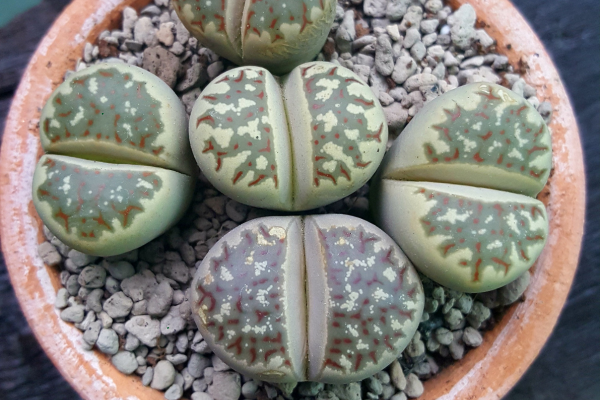
The most reliable visual distinction comes down to body shape and the way each plant splits and grows. Lithops form a pair of fused, thick leaves that create a single, solid-looking body, often with a distinctive fissure or slit across the top where new leaf pairs will eventually emerge. The overall shape tends to be more angular, more clearly divided into two lobes, and the surface patterning, the windowed markings unique to each species, is usually concentrated on the flat or slightly domed top surface of the plant.
Conophytum bodies are generally more fused and rounded, often appearing as a single, unified globe or button rather than two clearly distinct lobes. The split at the top, where flowers and new growth emerge, tends to be smaller and less prominent than the more pronounced fissure typical of Lithops. Conophytum species also show far more variation in overall shape across the genus than Lithops does, ranging from tightly spherical forms to more elongated, cone-shaped bodies, which is part of why Conophytum has become such a popular genus among collectors chasing variety within a single group.
Color and surface texture can help too, though this is less reliable since both genera show enormous variation species to species. Lithops surface patterns tend toward more defined, almost cellular windowing, dots, lines, and translucent patches arranged in fairly structured patterns. Conophytum surfaces are often smoother and more uniformly colored, though certain species do show their own distinct patterning and texture.
Dormancy: The Difference That Actually Matters Most
If there’s one distinction that matters more for keeping either plant alive than any visual cue, it’s dormancy timing, and this is where the two genera genuinely diverge in a way that has direct care consequences. Lithops are summer dormant, slowing down significantly during the hottest months and doing their active growing and flowering in the cooler parts of the year. Conophytum species are also broadly summer dormant, but the specifics of their growth calendar, when they emerge from dormancy, when they flower, when the old leaf pair fully desiccates, often run on a slightly different schedule than Lithops even within the same general season.
Understanding this connects directly to something worth knowing regardless of which genus you’re growing: how to actually recognize dormancy periods in rare succulents rather than mistaking a normal seasonal pause for a problem. Misjudging dormancy timing is one of the most common ways collectors lose both Lithops and Conophytum, watering during a period when the plant’s root system genuinely cannot process it safely, and the two genera are unforgiving enough about this mistake that getting the timing right matters more here than it does for most other succulents.
The Leaf-Shedding Process, and Why It Confuses People
Both genera undergo a process where the old leaf pair or body is gradually consumed and replaced by new growth emerging from within, and this process is one of the most alarming things a new grower can witness without knowing what’s happening. The old tissue shrivels, sometimes dramatically, sometimes turning papery and discolored in a way that looks exactly like the plant is dying. In reality, this is completely normal and represents the plant successfully transferring its stored resources into the new growth beneath.
The confusion between genera comes in here too, because the timing and appearance of this process differs slightly. Lithops typically shed a single old leaf pair as one new pair emerges from the split. Conophytum can be a bit more variable, with some species producing new growth that emerges more gradually from within the old, shrinking body. Recognizing this as normal, in either genus, rather than reacting to it as a health emergency, is part of what separates confident mesemb growers from people who panic and overwater at exactly the wrong moment, compounding a nonissue into an actual problem.
Why the Confusion Persists, and Why It’s Worth Sorting Out
Part of the reason these two genera get blurred together so often comes down to how they’re marketed and sold. Generic succulent retailers frequently label anything small, stone-like, and unfamiliar as simply a “living stone,” without distinguishing genus at all, and casual care advice online often applies a single blanket set of instructions to both. For a genuinely rare or expensive specimen, that kind of imprecision is a real problem, since getting watering timing wrong by even a few weeks, based on incorrect assumptions about which genus you’re actually growing, can be enough to kill a plant that survived shipping and acclimation just fine.
Taking the time to properly identify which genus, and ideally which species, you’re actually growing pays off in exactly the kind of specificity that generic care advice can’t provide. It’s a small amount of upfront effort that prevents the kind of confident mistake I nearly made handing off a misidentified plant at a swap table, and it’s the difference between following advice that’s approximately right and advice that’s actually correct for the specific plant sitting in front of you.
