
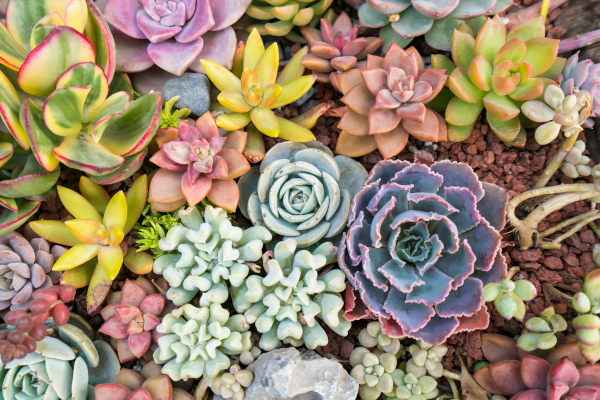
There’s a particular kind of quiet obsession that comes with collecting succulents. It usually starts small — a single Echeveria on a windowsill, maybe a gift from a friend who “just thought it looked nice.” Then one plant becomes three, three becomes a shelf, and before long you’re scrolling through late-night auction listings trying to figure out whether that variegated rosette is actually as special as the seller claims. If any of that sounds familiar, you already understand why rare succulents have become such a fascinating corner of the plant world.
What makes a succulent “rare” isn’t always obvious at first glance. Sometimes it’s genetics — a mutation that occurs in maybe one out of ten thousand seedlings. Sometimes it’s geography, with a species growing only in a narrow strip of cliffside in a specific region of Mexico or South Africa. And sometimes it’s simply a matter of how slowly a plant grows, which makes commercial propagation painfully impractical for nurseries chasing faster turnover. Whatever the reason, the following ten varieties have earned their reputation among collectors, and getting to know them is a great starting point if you’re building a serious collection — or just trying to understand what all the fuss is about.
Haworthia Cooperi var. Truncata
Haworthias tend to fly under the radar compared to flashier succulents, but this particular variety has a cult following for good reason. Its leaves are translucent at the tips, almost like tiny windows, which allow light to filter down into the plant in its natural rocky habitat. When grown well, the effect looks almost otherworldly — like a cluster of soft, semi-transparent marbles clustered together. The tricky part is that Haworthia Cooperi var. Truncata is notoriously slow-growing and sensitive to overwatering, so most of the specimens available commercially come from patient growers who’ve nurtured them for years rather than months. If you’re curious about the finer details of identifying different Haworthia types, it’s worth reading our companion piece on distinguishing Haworthia Cooperi from Haworthia Obtusa, since the two are frequently mislabeled by casual sellers.
Lithops (Living Stones)
Few succulents generate as much double-take curiosity as Lithops. They’re often mistaken for actual pebbles until they bloom, at which point a bright daisy-like flower emerges from what looked like a solid stone just days earlier. Native to the arid regions of southern Africa, Lithops have evolved this camouflage as a defense against grazing animals, and that same evolutionary quirk is exactly what makes them so captivating to grow at home. They’re deceptively difficult, though. Overwatering during their dormant period is the single most common cause of death among beginner Lithops owners, and the rules around when and how much to water genuinely go against most people’s succulent instincts. We go much deeper into the identification process, including how to tell juvenile Lithops from mature ones, in our dedicated Lithops identification guide.
Variegated Monstera-Adjacent Succulents
While Monstera variegation gets most of the internet’s attention, succulent variegation is arguably rarer and, in many cases, more valuable per plant. Variegation occurs when a genetic mutation prevents certain cells from producing chlorophyll, resulting in streaks or patches of white, yellow, or pink across the leaf. The catch is that variegated succulents grow slower than their solid-green counterparts because they have less chlorophyll to fuel photosynthesis. This slower growth, combined with the instability of the mutation itself — variegated growth can sometimes revert back to solid green — is exactly why prices for a well-variegated specimen can climb into the hundreds of dollars. Collectors chasing this look often end up frustrated when a plant they paid a premium for slowly “reverts,” which is a heartbreak worth understanding before you buy.
Echeveria ‘Black Prince’
Not every rare succulent earns its status through delicate translucence or unusual mutation. Sometimes it’s just about color, and few succulents pull off deep, near-black tones as convincingly as Echeveria ‘Black Prince’. The dark pigmentation intensifies with strong sunlight and cooler temperatures, meaning the same plant can look almost green in low light and nearly black under the right autumn conditions. Because achieving that deep coloration requires very specific light exposure, many home growers end up with a washed-out, greenish version of the plant rather than the striking near-black rosette they were hoping for — which is part of what keeps well-colored specimens in demand.
String of Dolphins (Senecio peregrinus)
This one tends to get lumped in with the more common String of Pearls, but it’s a genuinely different plant — a hybrid, in fact, believed to be a cross between Senecio rowleyanus and Senecio articulatus. The leaves curve into a shape that unmistakably resembles a pod of leaping dolphins, which sounds like marketing hype until you actually see one in person. Because it’s a hybrid rather than a naturally occurring species, propagation is slower and less predictable, and healthy mature specimens with long, well-developed trails are still relatively hard to come by. If you’re trying to figure out which of these trailing succulents is right for your space, our comparison of String of Pearls and String of Dolphins breaks down the practical differences in care and growth habit.
Aloe Polyphylla (Spiral Aloe)
Native to the Lesotho highlands in southern Africa, Spiral Aloe is instantly recognizable by its geometrically perfect spiral rosette — a pattern that follows the Fibonacci sequence with an almost unsettling precision. It’s also one of the most difficult succulents on this list to grow successfully outside its native climate. Spiral Aloe wants cool temperatures, excellent drainage, and a very specific balance of moisture that doesn’t translate well to typical houseplant conditions. Many growers who attempt it from seed never see the spiral fully develop, which is part of why mature, well-formed specimens command such high prices at specialty auctions.
Crested and Monstrose Succulents
Crested growth, sometimes called cristate growth, happens when the growing point of a plant mutates and produces a fan-shaped or wavy ridge of new growth instead of the typical single point. It’s a genetic quirk rather than a distinct species, which means crested forms can technically occur in almost any succulent — but they occur rarely, and once a crested specimen is found, it has to be propagated carefully to preserve the mutation. Monstrose growth is a related but distinct mutation, producing irregular, lumpy, sculptural forms rather than the fan shape of crested growth. Both types are prized precisely because no two specimens ever look quite the same, and there’s no reliable way to intentionally produce one — you’re essentially waiting for nature to make a mistake in your favor.
Tephrocactus articulatus ‘Papyracanthus’ (Paper Spine Cactus)
Technically a cactus rather than a true succulent in the botanical sense, this one still belongs on any serious collector’s radar because of how differently it behaves compared to typical spiny cacti. Instead of sharp, rigid spines, it produces long, papery, almost feather-like growths that curl and twist as the plant matures. It’s slow to establish and doesn’t tolerate root disturbance well, which means specimens are usually grown from offsets taken carefully from an established parent plant rather than propagated at scale.
Euphorbia Obesa (Baseball Plant)
Shaped almost exactly like its namesake, Euphorbia Obesa has become increasingly difficult to source ethically because wild populations in South Africa have been heavily impacted by illegal collection. Responsible growers now propagate it from seed, which is a slow process — it can take several years for a seed-grown specimen to reach a size worth displaying. Because of this, and because the species is protected under CITES regulations restricting international trade of wild specimens, legitimately sourced Euphorbia Obesa tends to carry a noticeably higher price tag than its simple appearance might suggest.
Ariocarpus fissuratus (Living Rock Cactus)
This one might be the ultimate patience test for a collector. Native to the Chihuahuan Desert, Ariocarpus fissuratus grows so slowly that a specimen the size of your palm might be several decades old. Its rough, fissured texture genuinely resembles a chunk of weathered rock, and it stays mostly buried at soil level in habitat, with only the textured crown visible above ground. Because of both its slow growth and its wild-collection sensitivity, nearly all ethically available specimens today come from dedicated seed growers who’ve been cultivating them for years, sometimes decades, before they’re ever offered for sale.
Building familiarity with these ten varieties won’t make you an expert overnight, but it does give you a real foundation for understanding why the rare succulent world works the way it does — why prices vary so wildly, why some plants take years to become available, and why patience tends to be rewarded far more than impulse buying. If you’re just starting to build a collection, it’s worth pairing this knowledge with a solid understanding of soil and light requirements before bringing any of these home, since a rare plant purchased on a whim rarely survives long under the wrong conditions.
The rare succulent hobby rewards close observation more than almost any other kind of gardening. You start to notice subtle differences in leaf texture, the way a rosette tightens under stronger light, the faint blush of color that shows up right before a plant needs water rather than after. None of that comes from reading alone — it comes from actually growing the plants, watching them struggle sometimes, and slowly learning what each one is trying to tell you.
