
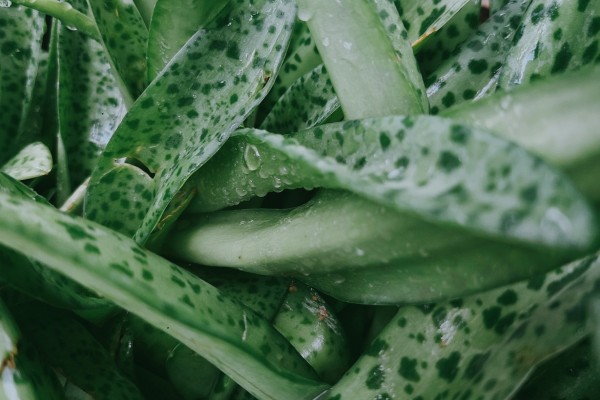
I spent nearly a month treating a spotting problem on one of my Echeverias with a fungicide that did essentially nothing, watching the dark, water-soaked lesions continue spreading despite consistent, correctly applied treatment. It wasn’t until I finally asked in a collector forum, posting close-up photos, that someone pointed out the spots had the wrong texture and pattern for a fungal issue entirely, and were far more consistent with a bacterial infection instead, something my fungicide was never going to touch no matter how faithfully I applied it. That distinction, one I’d never really considered as relevant before, turned out to be the entire reason my treatment wasn’t working.
Black or dark spotting on succulent leaves is one of the most common problems collectors encounter, and also one of the most frequently misdiagnosed, largely because both fungal and bacterial infections can produce superficially similar dark lesions, while requiring genuinely different treatment approaches to actually resolve. Learning to tell them apart, rather than defaulting to fungal treatment simply because it’s the more commonly discussed option, makes an enormous difference in whether treatment actually works.
Why These Two Causes Get Confused So Often
Both fungal and bacterial pathogens can produce dark, discolored lesions on succulent leaves, and in the early stages particularly, the visual difference between them can be subtle enough that even experienced growers sometimes need close inspection to distinguish one from the other. Generic succulent care advice also tends to default to discussing fungal issues far more often than bacterial ones, simply because fungal problems tend to be more common overall in most growing conditions, which creates a natural bias toward assuming any spotting problem is fungal by default, even when the specific presentation doesn’t actually match that pattern.
This matters enormously in practice because fungicides, the go-to treatment most collectors reach for first, have no meaningful effect on bacterial infections. Treating a bacterial problem with fungicide, as I did for nearly a month, doesn’t just fail to help, it allows the actual infection to continue progressing unchecked while you’re mistakenly convinced you’re addressing it.
Distinguishing Characteristics of Fungal Spotting
Fungal lesions on succulent leaves typically present with relatively defined, often circular or oval borders, sometimes with a slightly raised or textured edge as the fungal growth establishes itself around the lesion’s perimeter. The center of a fungal spot often appears drier and more sunken over time compared to its immediate surroundings, and in more advanced cases, visible fungal growth, a fuzzy, powdery, or otherwise textured surface coating, may become apparent directly on the lesion itself, something bacterial infections essentially never produce.
Fungal spotting also tends to spread more gradually across a plant, expanding outward from an initial infection point over a period of days to weeks, with new spots appearing progressively rather than all at once. This connects to the same conditions discussed when writing about wind exposure and airflow’s role in succulent health, since fungal spores generally require a period of surface moisture to establish an infection, meaning stagnant, humid conditions considerably increase fungal spotting risk in a way that’s worth investigating alongside any active fungal problem, addressing the environmental cause alongside direct treatment of existing lesions.
Distinguishing Characteristics of Bacterial Spotting
Bacterial lesions, by contrast, often appear more irregular in shape, with softer, less clearly defined borders than typical fungal spots, and frequently present as somewhat translucent or water-soaked in appearance, particularly in their early stages, a texture and appearance genuinely distinct from the drier look fungal lesions tend to develop. Bacterial infections can also progress considerably faster than fungal ones under favorable conditions, sometimes visibly worsening within just a day or two rather than the more gradual spread typical of fungal spotting, which was ultimately one of the clues that should have tipped me off sooner in my own case.
A somewhat unpleasant but genuinely useful diagnostic sign, when present, is odor. Bacterial infections, particularly as they progress, often produce a distinctly unpleasant, sometimes described as fishy or rotten, smell that fungal infections typically don’t share, since the mechanisms of bacterial tissue breakdown differ from fungal decay in ways that produce genuinely different byproducts. If a spotted or lesioned area of a plant has any noticeable off odor, that’s a meaningfully strong signal pointing toward a bacterial rather than fungal cause.
Why Getting the Diagnosis Right Changes Treatment
Fungal infections respond to fungicidal treatments, copper-based fungicides in particular are widely used and reasonably effective across a broad range of common succulent fungal issues, combined with the kind of environmental adjustments, improved airflow, reduced surface moisture, that address the conditions fungal spores need to establish themselves in the first place.
Bacterial infections require a genuinely different approach, since there’s no equivalent over-the-counter bactericide as broadly effective or accessible as common fungicides. Treatment instead focuses heavily on physically removing infected tissue promptly, using clean, disinfected tools following the kind of hygiene practices discussed when covering how to disinfect tools between plants, since bacterial pathogens spread readily through contaminated cutting surfaces and contact between infected and healthy tissue. Reducing surface moisture and improving airflow help here too, similar to fungal prevention, but the core response leans more heavily on aggressive removal of affected tissue and strict containment than on any direct chemical treatment applied to the infection itself.
Isolating any plant showing suspected bacterial infection immediately is particularly important given how quickly these infections can spread compared to many fungal issues, following the same reasoning behind isolating plants with suspected pest problems before confirming a full diagnosis. Bacterial infections in particular can move from plant to plant through water splash, shared tools, or even direct leaf contact between closely spaced plants, making rapid isolation one of the most effective early responses regardless of how confident you are in the diagnosis yet.
When You’re Genuinely Unsure
Even with careful observation, some cases remain genuinely ambiguous, particularly in early stages before a lesion has developed enough distinguishing characteristics to diagnose confidently either way. In these situations, isolating the affected plant immediately, removing any clearly compromised tissue with properly disinfected tools, and improving airflow and reducing surface moisture, steps that support recovery from either fungal or bacterial causes, provides a reasonable starting response while continuing to monitor how the lesions develop over the following days for clearer diagnostic signs.
The Value of Slowing Down Before Treating
My month of ineffective fungicide treatment was ultimately a lesson in the cost of assuming rather than actually examining a problem closely before responding to it. Taking the time to genuinely compare a lesion’s texture, border definition, progression speed, and any accompanying odor against the distinguishing characteristics of both fungal and bacterial causes, rather than reaching immediately for the more commonly discussed treatment, saves both the wasted time I experienced and, more importantly, the additional weeks a misdiagnosed infection gets to continue spreading unchecked while the wrong treatment is being applied.
